Smooth Stones

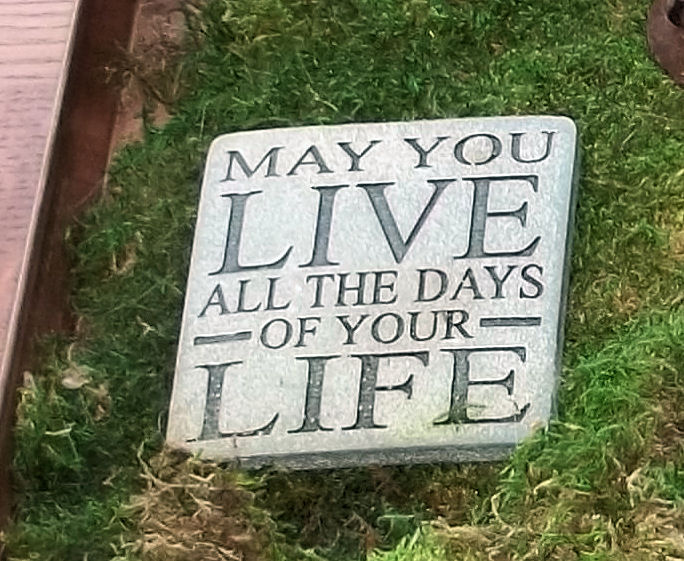
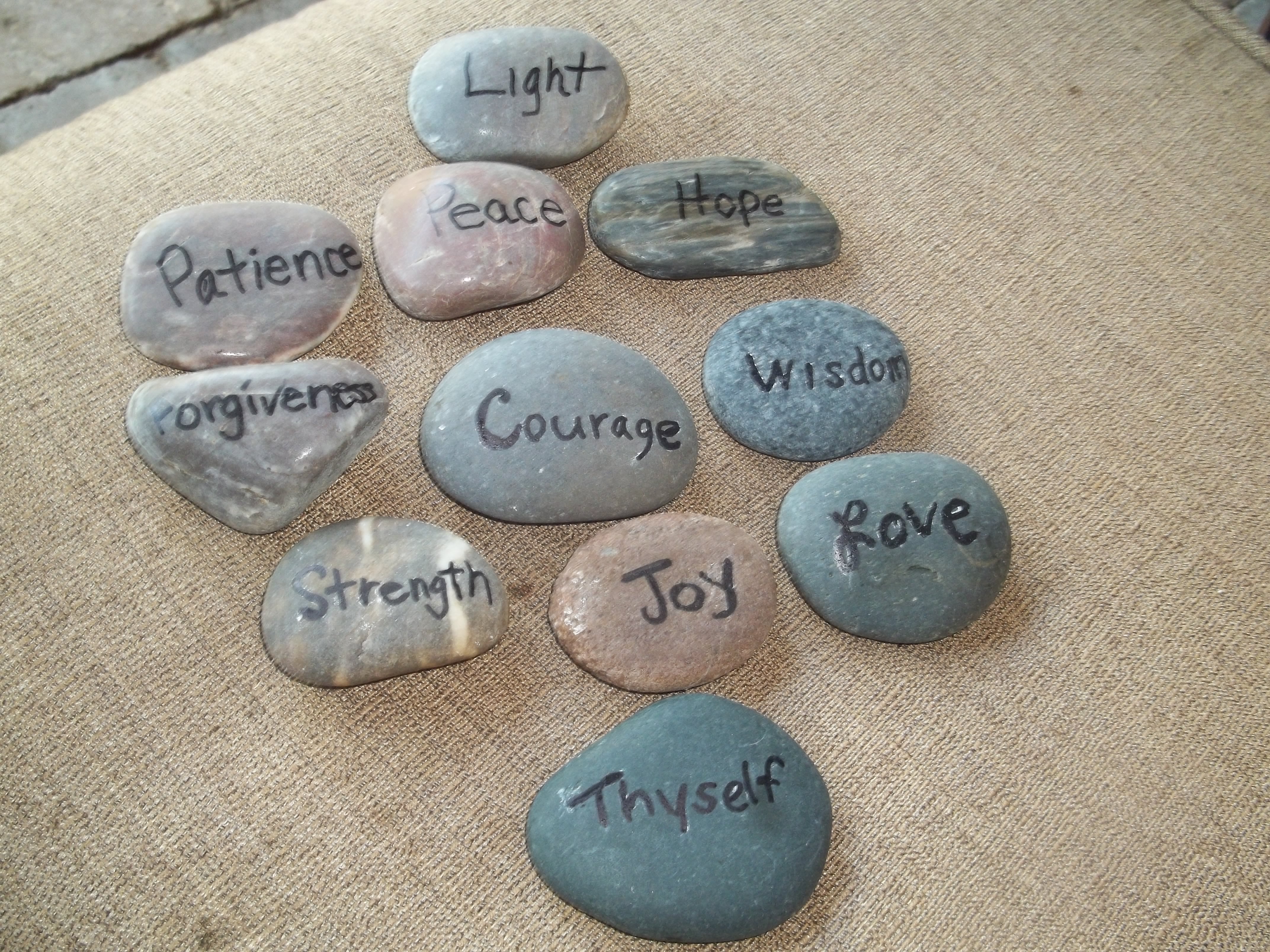
I keep a small basket of smooth stones, each marked with a word,  on the back porch which I use like prayer beads. Somehow, as I lift a stone and place it beside me with a prayer for each thing the word I have written there represents, I am able to focus more sharply and receive these gifts.  I keep the same list by the coffee pot in the kitchen and can cover it with the palm of my hand in my petition.  Laying the stones down is a random process, so I am drawn to the pattern on this particular day when I look at all of them together.   I begin with seeking Light and the progression leads me to the most important request, “Thyself.”  I realize that if I could have only one request it must be that, for it is in the presence of God I find the all the rest.

The poetry of John O Donahue helps me imagine he might have had a basket of stones, too.

May I live this day

Compassionate of heart,

Clear in word,

Gracious in awareness,

Courageous in thought,

Generous in LOVE.

– John O’Donohue
Lagniappe

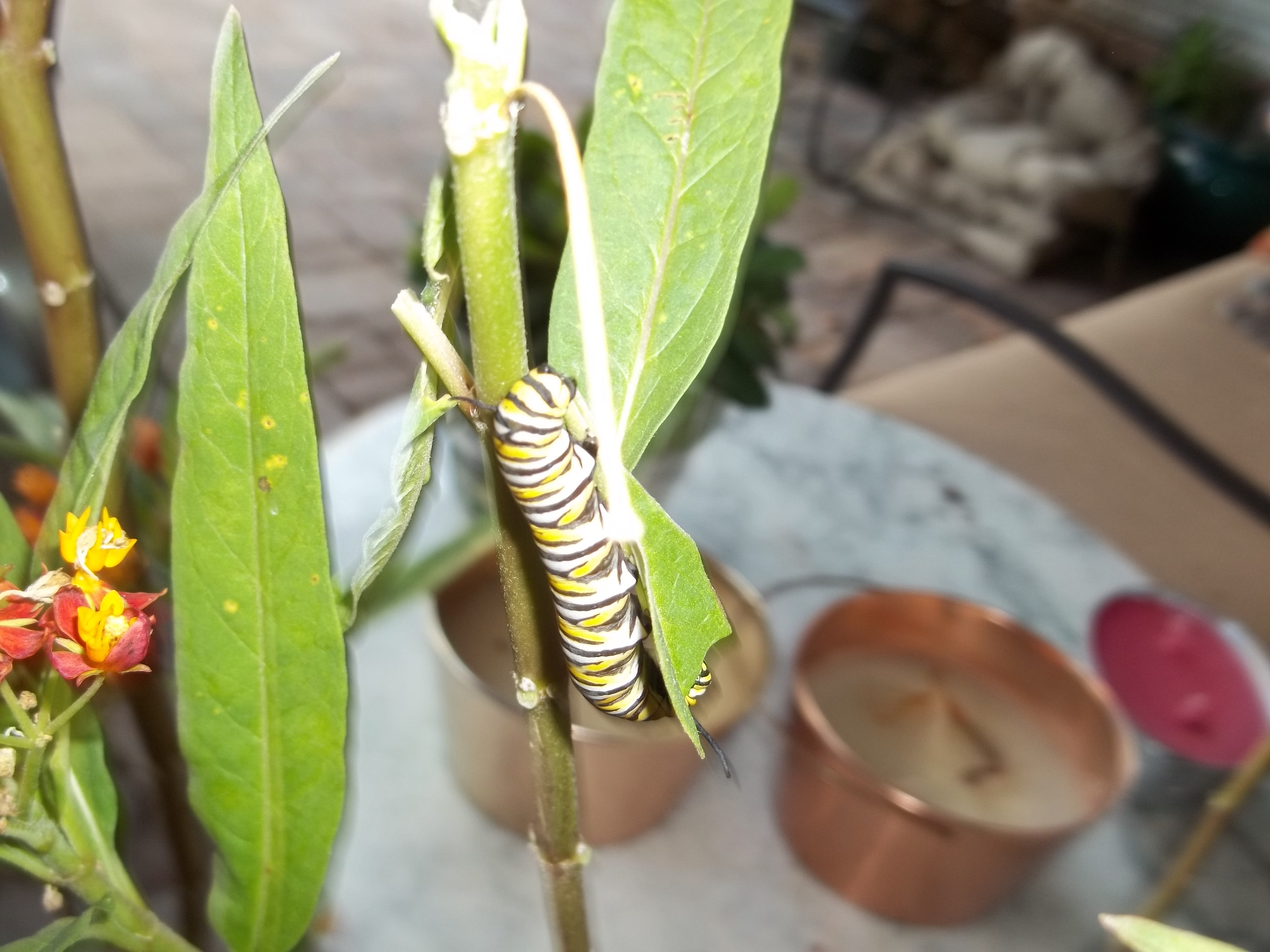
Recently our favorite garden center had a greenhouse sale. It is hard for me to pass up plants we love to have in our garden on sale for $2, so I came home with a large healthy milkweed.  I parked it on the back porch until I could pick a good spot in the yard for it. I shouldn’t be surprised since I know that milkweed is the only plant on which Monarch butterflies lay their eggs, but was pleasantly amazed the next day when I discovered my lagniappe – 6 tiny caterpillars munching away at the milkweed leaves.  I had to laugh as I remembered a conversation I overheard while I was looking at the nursery plants.

A lady standing next to me said  yes, this was a good buy for such a large plant but she had one like it and caterpillars kept eating it up.  I smiled and reassured her that meant she would have alot of butterflies, too, since the caterpillars would crawl off to neighboring spots, form a chrysalis, and emerge as Monarchs.  She looked at me and stomped off complaining that the butterflies were OK but she couldn’t take the caterpillars.

It is true, the little yellow and black wigglers completely stripped my new plant, so much that I took caterpillars and all out to another milkweed in the garden and let them lunch there too.  Within a few days there were no leaves left, and no caterpillars either.  Now as I enjoy the flickering color of butterfly wings I am happy they had what they needed to become what they are.  Today I see that both milkweed plants have new leaves popping out all along their branches. I am thankful for learning to let the caterpillars be.

Mark Twain writes about the word in a chapter on New Orleans in Life on the Mississippi (1883). He called it “a word worth traveling to New Orleans to get”:

We picked up one excellent word — a word worth travelling to New Orleans to get; a nice limber, expressive, handy word — “lagniappe.” They pronounce it lanny-yap. It is Spanish — so they said. We discovered it at the head of a column of odds and ends in the Picayune, the first day; heard twenty people use it the second; inquired what it meant the third; adopted it and got facility in swinging it the fourth.”…  It is something thrown in, gratis, for good measure.

See and Tell

Pay attention         Be astonished        Tell about it       ~Mary Oliver

Small children often have a practice at school called show and tell.  That seems to be kin to Mary Oliver’s words.  First you have to notice, to really see before you can choose something to show or have its description to tell about.  I grow a great many herbs in my garden.  Each has unique characteristics of growth and appearance and fragrance. Part of the joy of tending this garden is in seeing and knowing the differences.

This Cuban Oregano is one of my favorites for its beauty – softly variegated colors on aromatic velvet leaves that I love to touch. I like the way it leans into our weathered wood fence as if to press its restoring oil into the splintered plank.  When I water the plants around it, I look for it, I pay it attention.  I am rewarded with fresh amazement at the loveliness of growing things, surviving the heat of summer and thriving.

“Seeing is of course very much a matter of verbalization.  Unless I call my attention to what passes before my eyes, I simply won’t see it.  It is, as Ruskin says, ‘not merely unnoticed, but in the full, clear sense of the word, unseen.’  I have to say the words, describe what I’m seeing…But if I want to notice the lesser cataclysms of valley life, I have to maintain in my head a running description of the present.”   ~ Annie Dillard, from Pilgrim at Tinker Creek

Not Always What it Seems

 
From Where You’re Standing
“What you see and what you hear depends a great deal on where you are standing.  It also depends on what sort of person you are.”   C.S. Lewis, The Magician’s Nephew
Most call it a weed
But it declares itself
Survivor
Victorious
Determined to reclaim territory
in grassy lawns, between flagstones, under a rose bush
Wildflower?
Native Texas Plant?
Field green when found in a bag at the store?
Its highest purpose blooms
in feathery puffs –
bane of gardener
delight of every child
who holds it up to make a wish
blowing away a cloud of laughter

Beyond First Sight

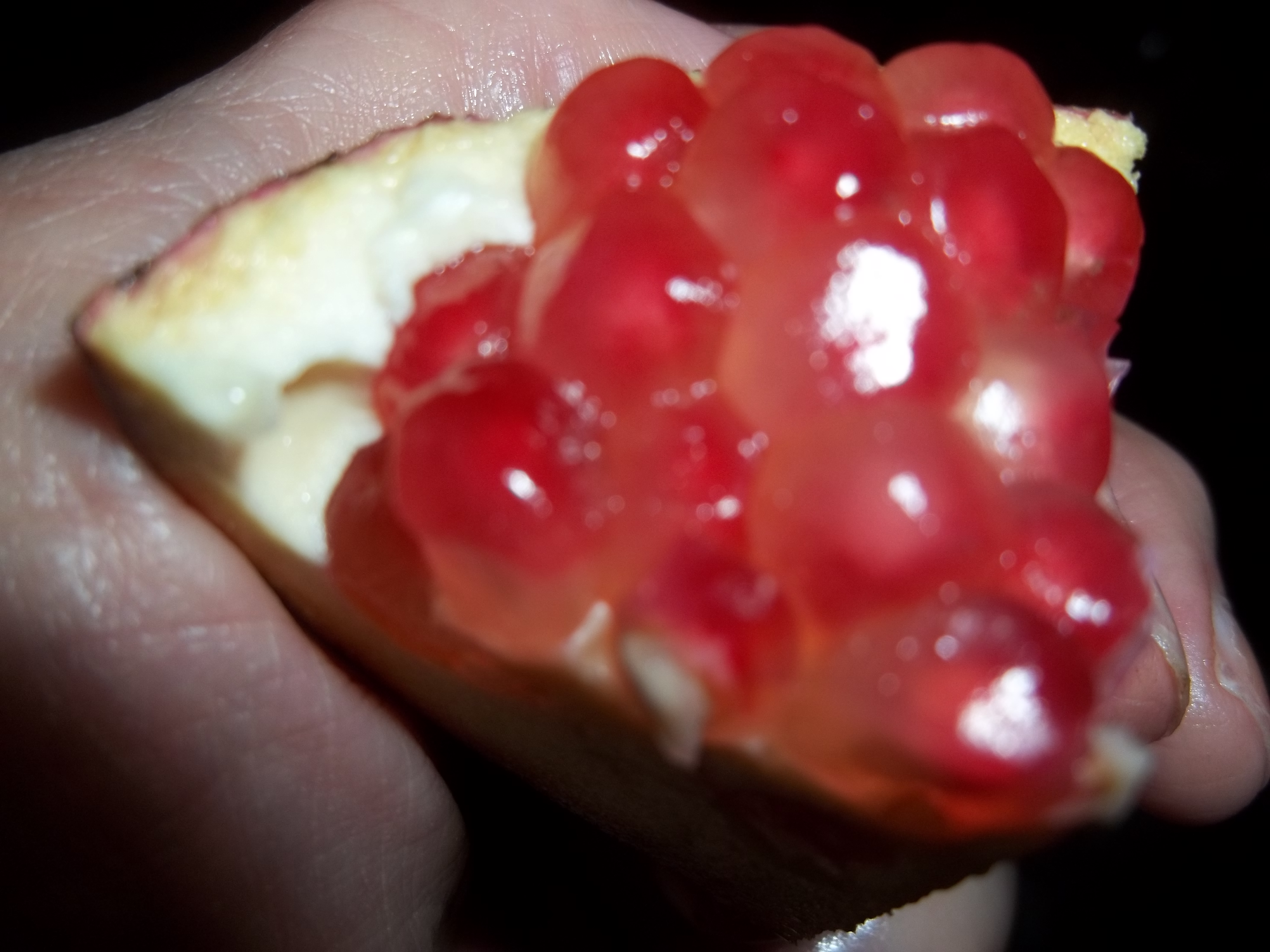
Our pomegranate harvest won’t win any beauty contests.  Most of the smallish globes that make the thin tree branches droop down don’t look at all like those available in supermarkets.  No luscious rounds of rouged skin here.  I am not sure what it is, but some blight attacked the trees and left these dark freckles on the skin of all our fruit. But I learned a long time ago that it is not what’s on the outside that counts with pomegranates and people.  I cut the tough skin, submerged the pieces in a bowl of water to break apart the arils inside, and look at the scarlet, glistening, juicy results!

Now comes the reward!  A handful of these seeds drips intense flavor and power packed nutrition!  I love the sweet yet tart pop of juice each tiny aril provides. We like them for snacks, but I will also use them to top salads, make salad dressings, and squeeze some for juice to freeze.

My garden as always teaches me truth – take time to look beyond the exterior. Soon it will be time to harvest the Meyer lemons.  I think their lesson is going to be “don’t give up!” It took a few years for this tree to have more than a few lemons but this year there are too many to count.  Don’t worry, I have a list of “100 things to do with Meyer Lemons!”

After the Bloom

I will repeat myself:  I love Magnolia trees. Just over a year ago, in May, 2011, I photographed Magnolia blooms from our tree, and posted them here with words about their beauty and my admiration of them.

We emphasize the fresh beauty of the flowers of so many plants in their seasonal displays of new life and color.  Rightly so, for it is in the flowering that many growing things are the most lovely and appealing.  We even use the term “gone to seed” to apply to things that are past this stage and  are not well kept or have declined to become rundown and useless. Indeed, the annuals in our gardens will run their course, finish their blooming, and wither with the first frost to die, be uprooted by the gardener, and replaced with new, young plants come Spring.

But oh my, what we miss if we enjoy only the blooming of the Magnolia.

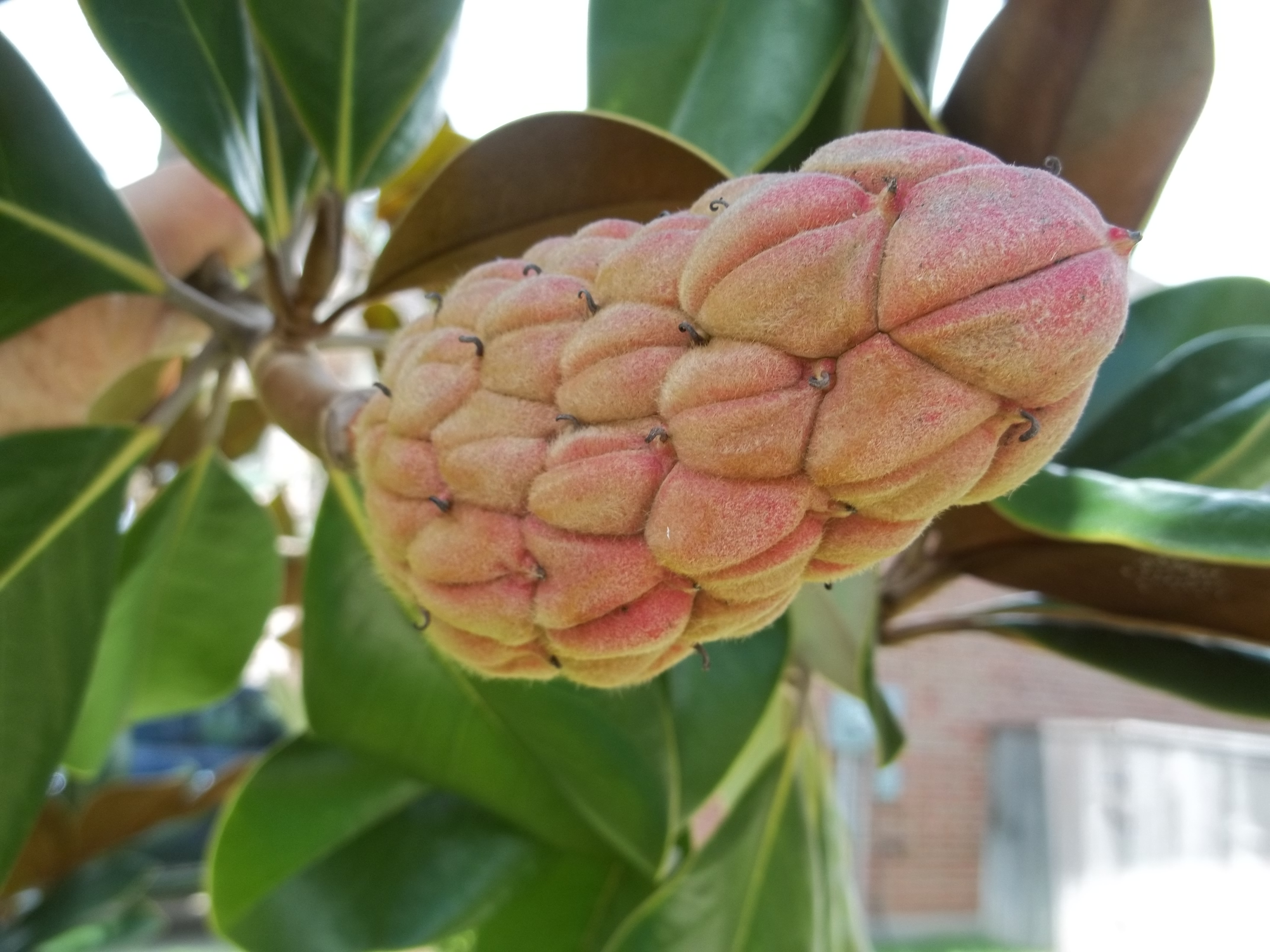
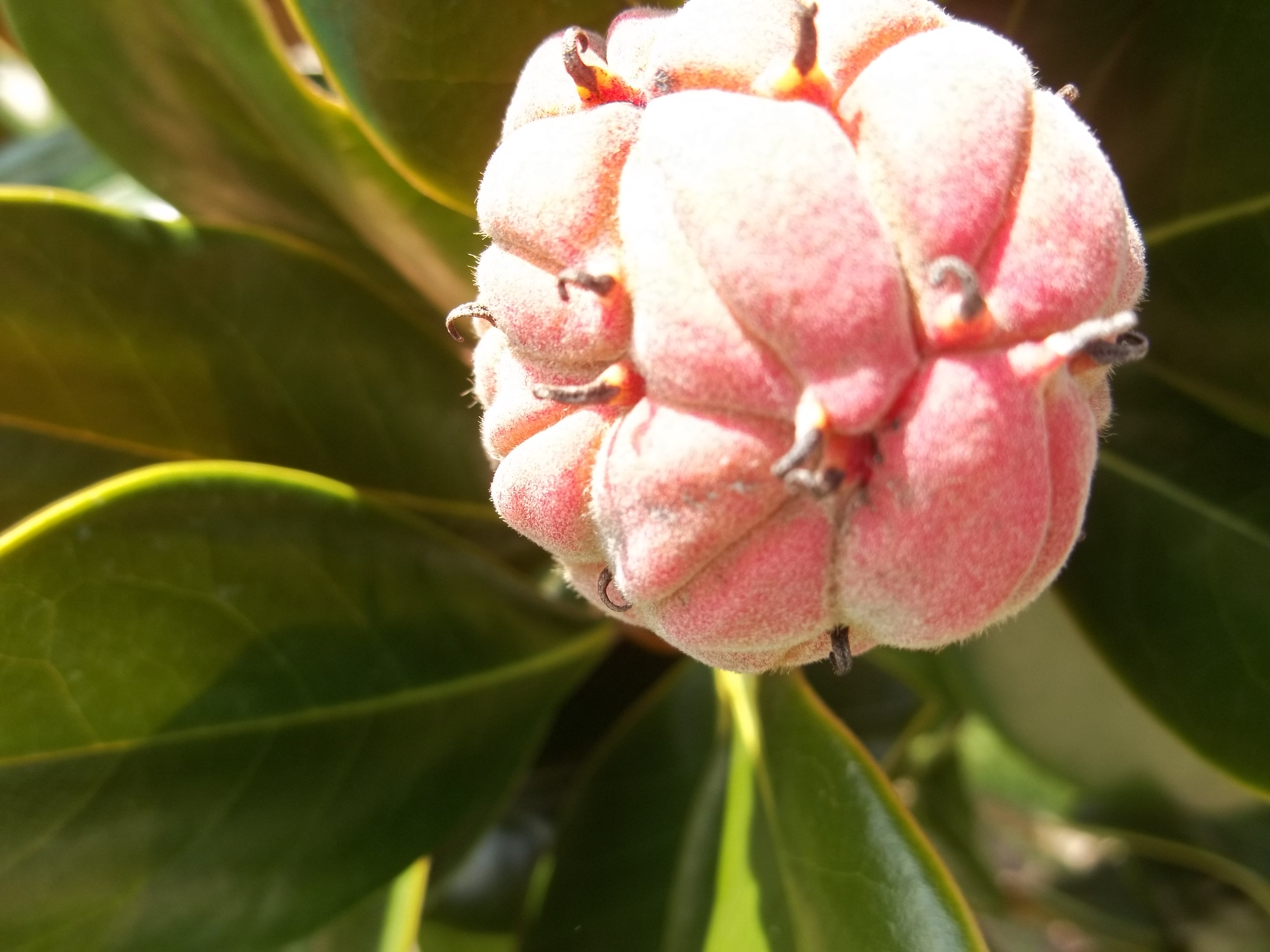
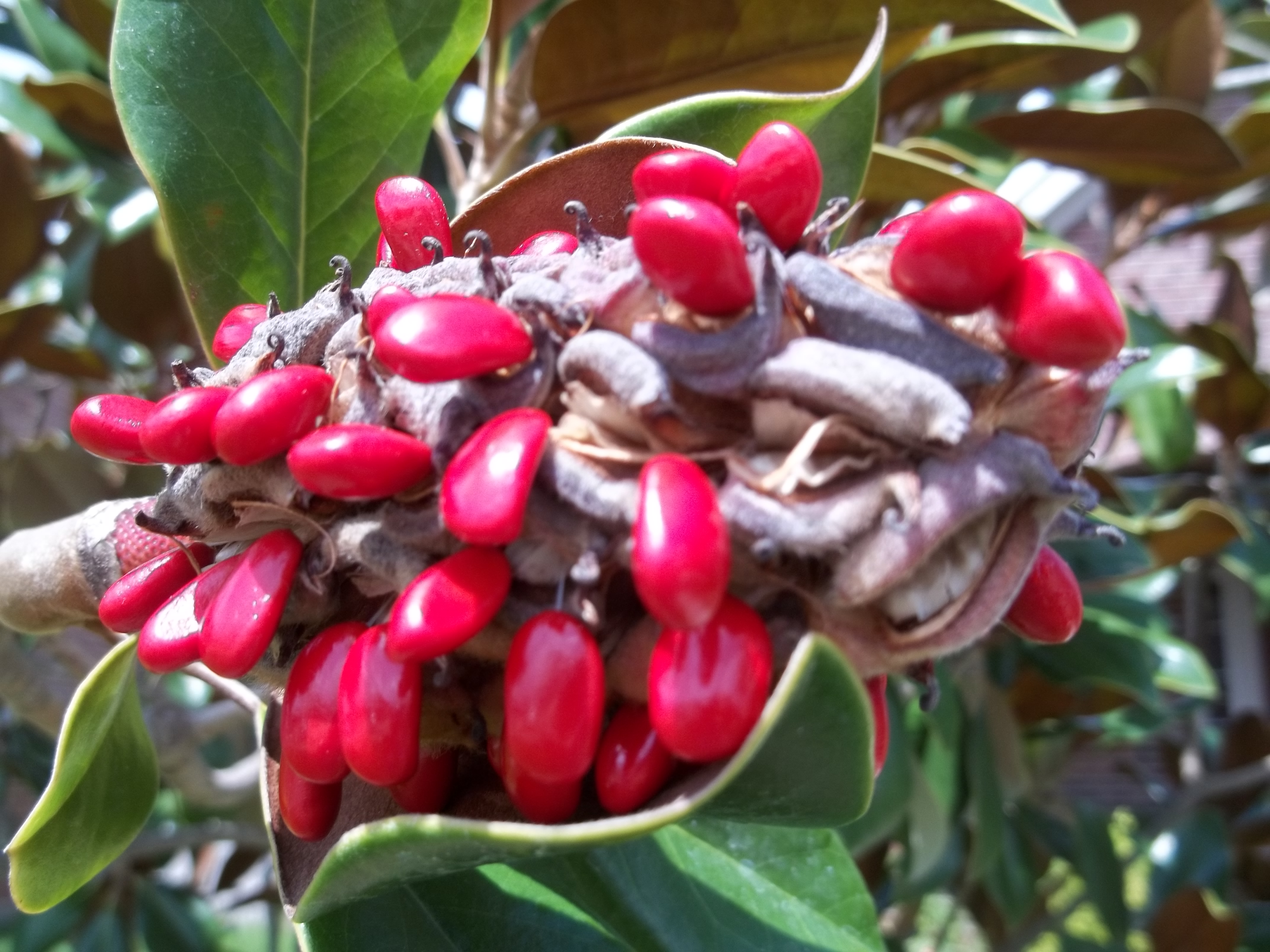
Once the creamy flower petals have become leathery and caramelized, they fall off, leaving a center cone that swells with seed. Early on, it resembles some exotic fruit, a blushing tufted pillow covered with velvet.

Left on the tree, the tufted pods begin to burst, revealing treasure inside: shiny scarlet seeds holding on with a single silken thread.

Songbirds love these seeds. Coveted by those who craft holiday wreaths and decorations, the vivid cones and seeds often get harvested by eager hands. If left alone, the seeds turn black and fall to the ground.  I think I love Magnolias even better after the bloom.

Interruptions?

“The great thing is, if one can, to stop regarding all the unpleasant things as interruptions in one’s “own” or “real” life. The truth is, of course, that what one regards as interruptions are precisely one’s life.”   ~C.S. Lewis

I am a list maker.  I make a list of at least 5 things I am grateful for every day. I keep a calendar where I list all commitments and appointments.  I make a menu list every week and grocery lists after that.  I have a list of things which must get done today, and a list of important matters which need to get addressed ASAP.  I have lists of projects I want to do someday and ones I intend to do this month or “for Christmas.”

I once kept a list (read journal) of meals I served for entertaining when we lived in Indonesia which included notes of foods which were favorites or those someone disliked.  As you see, some of these are lists for keeping and others which need to get checked off and discarded (replaced by new ones, of course.)

I have learned that lists get changed, rearranged, simplified.  I have learned, as C. S. Lewis says so well, that things happen which are not planned and are not on my list.

And I love that God, in His infinite grace and patience with me, has taught me that I don’t know all that I will face and need, and so to practice living with grace as the unexpected, and sometimes unwelcome parts of life occur. That (with the hymn “God of Grace and God of Glory” humming in my mind) I am given both the wisdom and courage for the living of this hour, which is precisely, my life.

I Know

“God is not a belief to which you give your assent. God becomes a reality whom you know intimately, meet everyday, one whose strength becomes your strength, whose love, your love. Live this life of the presence of God long enough and when someone asks you, “Do you believe there is a God?” you may find yourself answering, “No, I do not believe there is a God. I know there is a God.”              ~Ernest Boyer, Jr

                                                         Morning Glory

opening with abandon

act of eternal knowing

swirling indigo, unfolding star

royal blaze set by spark of morning light

act of eternal knowing

centered with ember of lingering moonlight

royal blaze set by spark of morning light

given with brilliant tenderness

centered with ember of lingering moonlight

indigo swirling, star unfolding

Gift of brilliant tenderness

opening with abandon

Pantoum ~ Mary Ann Parker   August 22, 2012

Attentiveness

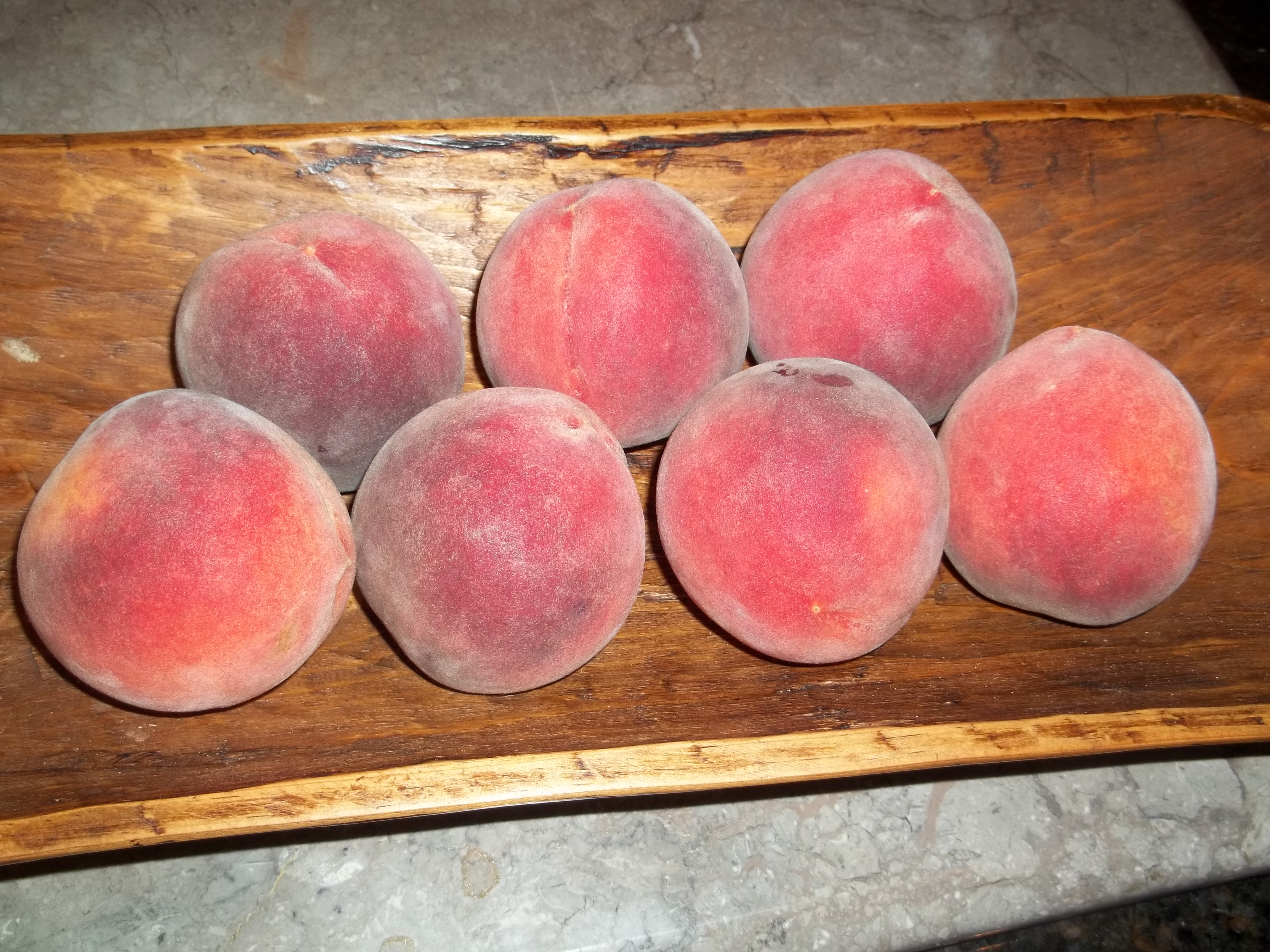
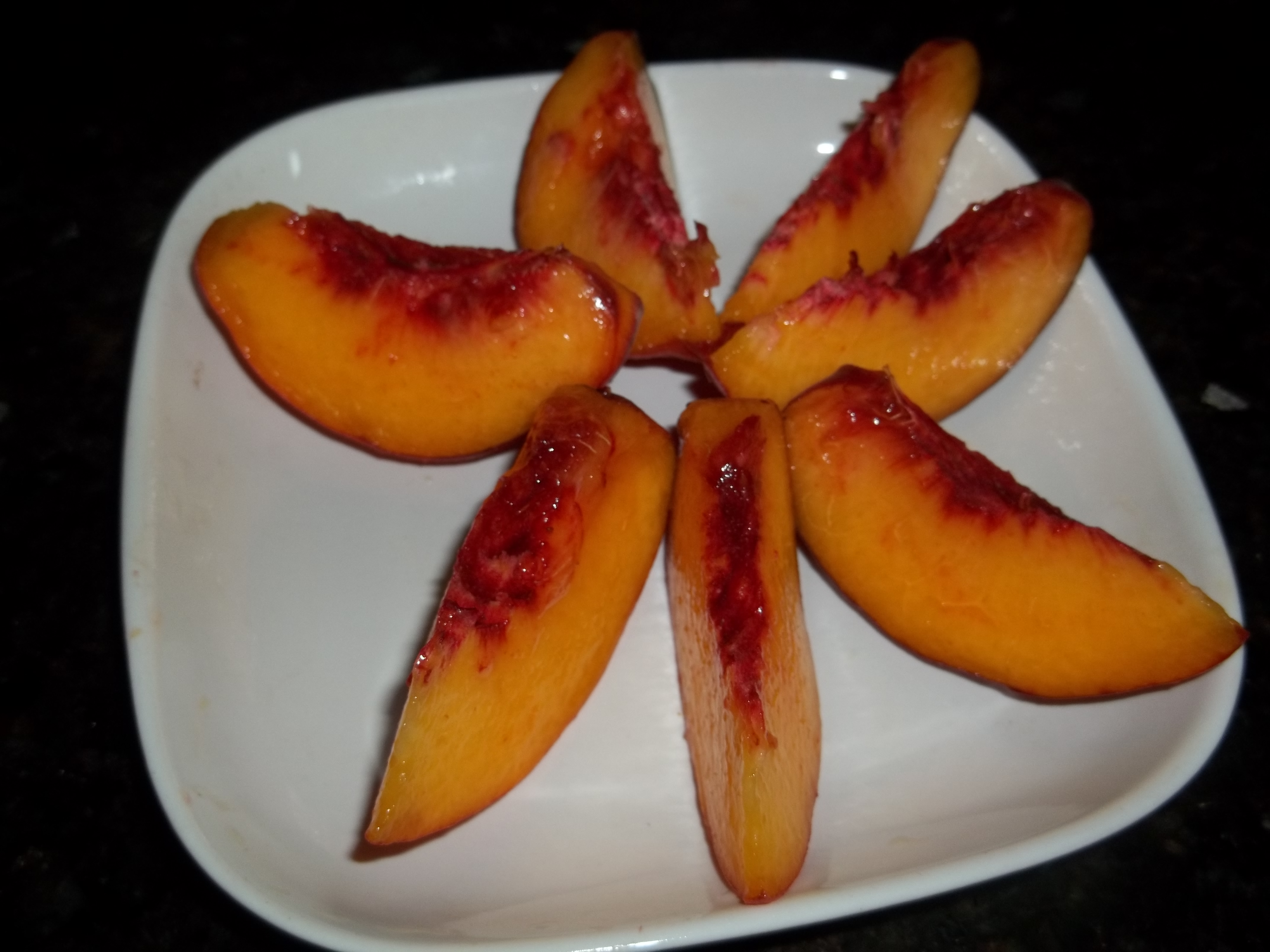
I use the lines from Mary Oliver which speak to paying attention, being astonished, and telling about it often.  I find it applies to so many things:  nature, of course, but also words that I read, objects that I find and touch, people and our conversation, both joys and pain.  My recent posts about paying attention with not only our eyes and ears but also our sense of smell sharpened my savoring of these extraordinary peaches!  They are a wonder to behold with their brilliant crimson and saffron colors, soft to the touch, and a succulent treat as you taste their sweetness. Even the seeds are so beautiful I can’t throw them away.  I have them lined up ready to let my granddaughter help me plant them.  When I enjoy a peach for breakfast, how could I not be attentive to the way it is beautiful inside and out?

“Ten times a day, something happens to me lie this – some strengthening throb of amazement – some good sweet empathetic pin and swell.  This is the first, the wildest, and the wisest thing I know: that the soul exists and is built entirely out of attentiveness.”   ~ Mary Oliver, New and Selected Poems, Vol. 1

“You can have the other words – chance, luck, coincidence, serendipity.  I’ll take grace.  I don’t know what it is exactly, but I’ll take it. ”  ~ Mary Oliver, Winter Hours

Breathe

When I visited one of the garden centers in Houston recently, this sign caught my eye since I had just written the previous post about fragrance.  Many of the plants in our back yard garden could be labeled “featuring fragrance.”  A plant that is new to me is actually a very old-fashioned one.  Sweet almond verbena reaches out to my nose with its sweet smell and a hint of vanilla.  It is no surprise to find that this reminds me to pray with each breath, inhaling God’s goodness and peace and letting out all my fretting. Remembering the Biblical references to our prayers as a fragrant incense, I smiled when I read that another name for this plant is Incense Bush.  Breathe!