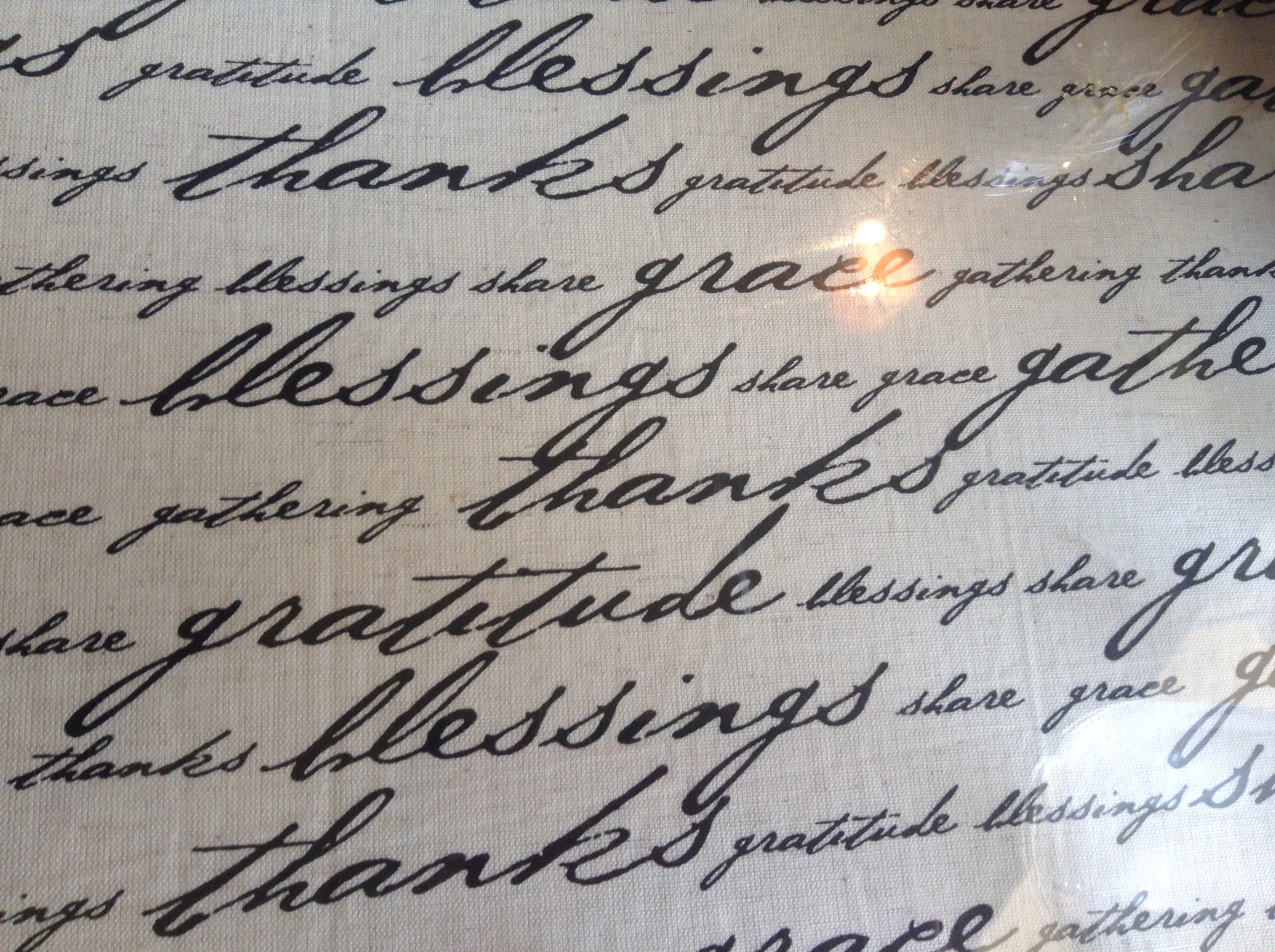
Word Gathering

IMG_2832These words are powerful all by themselves. At times when I am feeling overwhelmed or bewildered, I sometimes choose one just one to help me focus or to use in a breath prayer. But I love seeing them gathered like this.

blessings

thanks

share

peace

gratitude

all gathered together

leaning on each other

grace

What Is Mine to Do?

cereus

Photography courtesy of Pert Roddy Garraway, who grows these beautiful plants.

In my observance of Lent this year, I worked with others in an online retreat reflecting on the question “What is mine to do?”  The question comes from Jesus when he said” “What I just did was to give you an example: as I have done, so you must do.” When his own  death was approaching,  St. Francis told us, “I have done what is mine to do. May Christ teach you what is yours.”

For me, the answer to the posed question is simply that what is mine to do is to practice serving. I am not sure why, but my friend’s photo of her beautiful Cereus reminds me of serving.  It may be because this exquisite blooming only happens at night, when it is unseen by many. It does not require the brilliance of sunlight to bloom on, offering its beauty and fragrance. for a brief time.

I have become aware of the difference in helping, in fixing, as opposed to serving. When I worked as a registered nurse, my connection to patients was best applied in service to them and to their families as opposed to a goal of repair.  I am aware that in my community relationships, my parenting, and my grandparenting, my calling to serve may be played out in many different roles – in offering hospitality, in gardening and cooking and sharing the beauty of art and music. My joy in any of these is heightened as I realize that this, too, is serving.

“Serving is different from helping. Helping is not a relationship between equals. A helper may see others as weaker than they are, needier than they are, and people often feel this inequality. The danger in helping is that we may inadvertently take away from people more than we could ever give them; we may diminish their self-esteem, their sense of worth, integrity or even wholeness.

When we help, we become aware of our own strength. But when we serve, we don’t serve with our strength; we serve with ourselves, and we draw from all of our experiences. Our limitations serve; our wounds serve; even our darkness can serve. My pain is the source of my compassion; my woundedness is the key to my empathy.

Fixing and helping create a distance between people, but we cannot serve at a distance. We can only serve that to which we are profoundly connected.”

–Dr. Rachel Naomi Remen

Blooming Anyway

IMG_1716In our part of Texas, we seldom have severe winter weather.  Although November was colder than most years, December was unusually warm until Christmas. But 2015 turned a cold shoulder on us. It has been wet and cold, with twice the normal amount of rain and very cold – definitely coat, scarf, and glove days.  Since we have a few tender plants in our garden, when temperatures are predicted to drop to an extended period of hard freeze, we scuttle about trying to protect plants, pipes, and pets.  We haul out our stack of covers and  try to secure them in gusts of wind that take cover off as fast as we put it on while we weight or pin it down.  We didn’t cover our antique roses, but they seemed to welcome the wet cold days with an extra crop of blooms.  I have written before about the difference in color and fragrance in a winter rose bloom, but this round of blooming was so welcome in the bone chilling  cold, gray days that I found them particularly welcome.  These “Old Roses”  are known for their survival.  They come from root stock that is known for its stay power. The notable thing is that these roses didn’t just stay alive in the bitter cold and whipping winds. They bloomed anyway.

It is one thing to be grateful for having come from strong roots (the stories of my ancestors tell me over and over how much grit and grace they had)) – but it is another thing to be aware of  what I may be passing on to my sons and grandchildren. I want to live in ways that can be described as not just surviving, but blooming anyway.

Grace

toMarch312011 134

Still our prayer, for 2015…


For the New Year 1981
I have a small grain of hope–
one small crystal that gleams
clear colors out of transparency.

I need more.

I break off a fragment
to send you.

Please take
this grain of a grain of hope
so that mine won’t shrink.

Please share your fragment
so that yours will grow.

Only so, by division,
will hope increase,

like a clump of irises, which will cease to flower
unless you distribute
the clustered roots, unlikely source–
clumsy and earth-covered–
of grace

~Denise Levertov

Like Us

IMG_1411

Advent calls me to remember that Christ came to be one of us.  He came to be like us in all the imperfection of our messy lives.  Even his human family ancestry reflects this –  dotted with misfits and mistake- makers who also experienced grace, forgiveness and hope.

In Gail Godwin’s novel, Evensong,  a small town church in the Smoky Mountains is surprised when the local priest has a young teenage girl read the genealogy of Jesus recorded in Matthew  instead of the traditional Christmas story in Luke 2. The priest then quotes from an essay titled A Coming of Christ in Advent by Raymond Brown that says the genealogy list in Matthew 1 is “three minutes’ worth of tongue twisting names that  contain the essential theology of the Old and New Testaments for the whole Church, Orthodox, Roman Catholic, and Protestant alike…If so much  powerful stuff can have been accomplished down through the millenia by..people who were such complex mixtures of sinner and saint, isn’t that a pretty hopeful testament to the likelihood that God is using us, with our individual flaws and gifts, in all manner of peculiar and unexpected ways?

“Who of us can say we’re not in the process of being used right now, this Advent, to fulfill some purpose whose grace and goodness would boggle our imagination if we could even begin to get our minds around it?”

Found in Evensong, b


Grace, Simply a Gift

Grace

“After centuries of handling and mishandling, most religious words have become so shopworn nobody’s much interested anymore. Not so with grace, for some reason. Mysteriously, even derivatives like gracious and graceful still have some of the bloom left.

Grace is something you can never get but can only be given. There’s no way to earn it or deserve it or bring it about any more than you can deserve the taste of raspberries and cream or earn good looks or bring about your own birth.

A good sleep is grace and so are good dreams. Most tears are grace. The smell of rain is grace. Somebody loving you is grace. Loving somebody is grace. Have you ever tried to love somebody?

A crucial eccentricity of the Christian faith is the assertion that people are saved by grace. There’s nothing YOU have to do. There’s nothing you HAVE to do. There’s nothing you have to DO.

The grace of God means something like: “Here is your life. You might never have been, but you are, because the party wouldn’t have been complete without you. Here is the world. Beautiful and terrible things will happen. Don’t be afraid. I am with you. Nothing can ever separate us. It’s for you I created the universe. I love you.”

There’s only one catch. Like any other gift, the gift of grace can be yours only if you’ll reach out and take it.

Maybe being able to reach out and take it is a gift too.”

from Beyond Words: Daily Readings in the ABC’s of Faith by Frederick Buechner