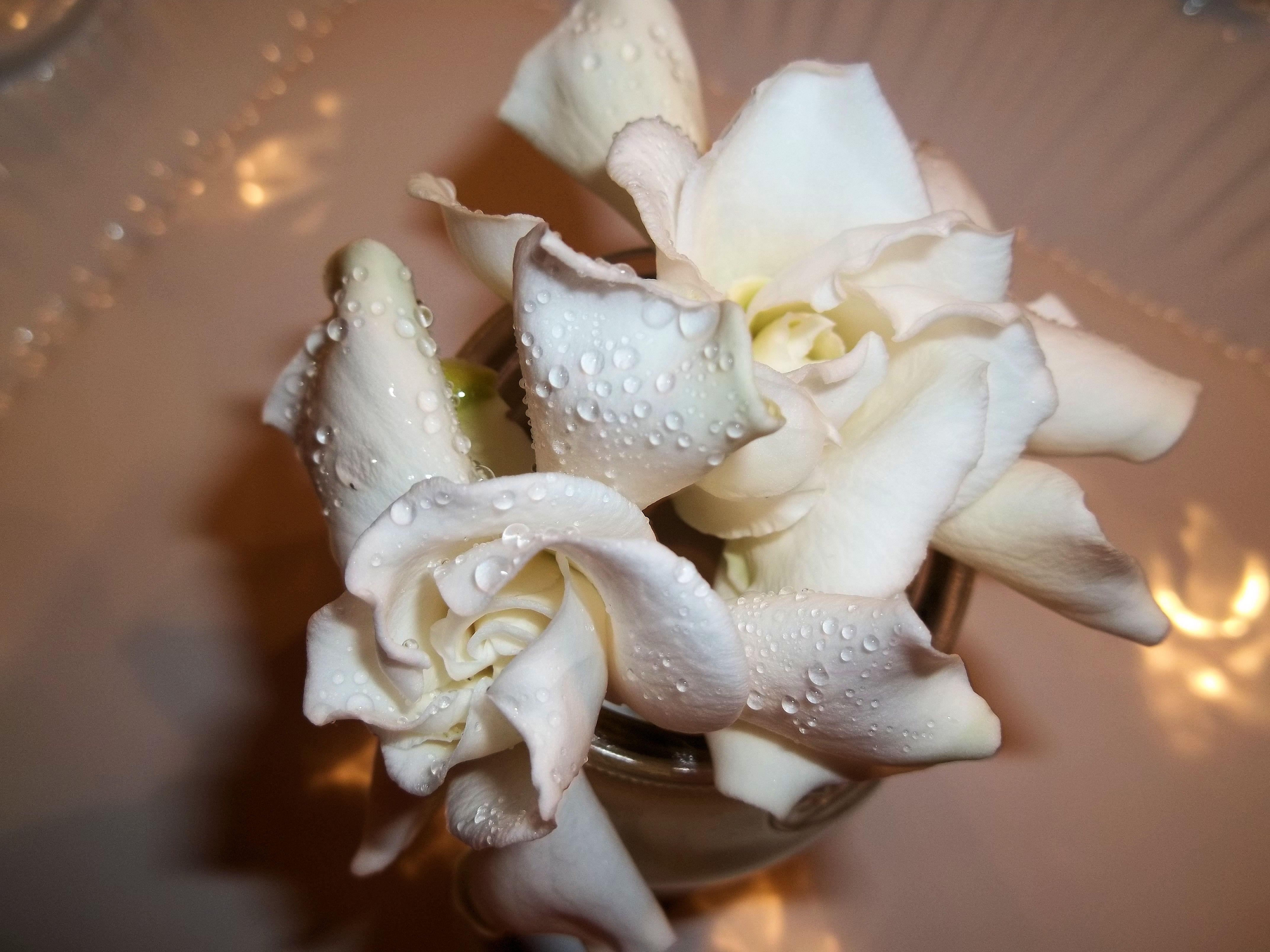
Fragrance


Paying attention is not just for eyes and ears. This week I am aware that being present to the fragrance in my garden brings a sharpened awareness of beauty and story. Joe brought these gardenias inside this morning. How lovely they are, shining with dew. But their sweet smell reached me before anything else.  I breathe deeply and say “thank you”, remembering all the way back to those that bloomed by our front porch when I was a little girl.


Pay Attention

“To pay attention, this is our endless and proper work.”   ~  Mary Oliver, “Yes! No!”

Joe and I attended the same highschool in Jacksonville, Texas . Over fifty years later, we talk about how grateful we continue to be for good teachers who taught us well, expected much, and by their example and instruction gave us more than knowing how to construct sentences, write paragraphs, solve equations, and appreciate art,  history,  geography, music and sports.  Lois Boles, Frances Childress, James Everett, Mr. Mosely, Signora Mullinix,  Jerry Robinson, Bill Ingram spring to mind quickly.  But a spry lady we called Miss Kate (Kate Stadler) who taught typing, used an expression so often in her classes that we still use it.   “Pay Attention!”  Miss Kate demanded attention to detail with expected results in skill and accuracy.  I am pretty sure she didn’t intend application beyond keyboard skills or think that as years went on, paying attention would be a skill that would become something to live by.  I am certain that I did not understand the phrase as more than a requirement until much later.  In its simplicity, there lies a risk of underrating its scope and impact. But it has become a compelling imperative, one that helps me see the intersection of faith and creation and art. No surprise, my favorite Mary Oliver quotation expresses this well.

“Instructions for living a life:

Pay attention…

Be astonished…

Tell about it!”              ~  Mary Oliver, “Sometimes”

Seeing

Recently I heard a radio interview with an artist who contended he wanted people to look at his work. He said folks go to “see” a movie, but people really “look” at paintings. Without mentioning there can be art in making films just as there is creative expression in other media, I disagreed in his use of the two viewings as one being superior to the other. I believe the question lies in whether either results in true recognition. From its beginning, Stones and Feathers has been a blog subtitled “A Different Way of Seeing.” Contemplative seeing, or seeing with the eyes of the heart is a work of the spirit as well as simply receiving images. So much of my photography and writing is simply an effort to pin down these results and express my gratitude for them.

This video was prepared by a student in a class taught by my friend Sheila Otto. Sometimes I experience something so penetrating and true I weep. My granddaughter Skye once told me the beauty in a red strawberry she was slicing made her whisper. When I viewed Dietrich Ludwig’s film, I cried while I whispered “Thank You.” I share the video with his permission and in tribute to my son, Ben, a man with an extraordinary, different way of seeing. His physical vision loss as yet has no surgical correction, but he lives every day with courage, fortitude, and the beauty that is experienced by seeing with the eyes of his heart.

Video from KarmaTube

The film also spoke to me since I was diagnosed in 2005 with Fuch’s corneal dystrophy for which there is no cure, only transplants as an option. My vision deteriorated so rapidly that I (who had been Ben’s reader and driver for so many years) became unable to read or drive. I received cornea transplants in May and July of 2006 and have very good vision at present although still followed closely by the surgeon. I am grateful to the two donor families who made these surgeries possible for me by their gifts.

Please note that the young man who created the video is dyslexic. He has trouble with letters and numbers, but pictures are his best way of learning and communicating. That is the reason he has chosen to work with photography. Thank you, Dietrich Ludwig, for what you see.

Is Happiness Green?

“Happiness? The color of it must be spring green, impossible to describe until I see a just-hatched lizard sunning on a stone. That color, the glowing green lizard skin, repeats in every new leaf… The regenerative power of nature explodes in every weed, stalk, branch. Working in the mild sun, I feel the green fuse of my body, too. Surges of energy, kaleidoscopic sunlight through the leaves, the soft breeze that makes me want to say the word “zephyr”—this mindless simplicity can be called happiness.”
—Frances Mayes
What color is my happiness? I could easily say Frances Mayes has said it all, that yes, the color of my happiness is spring green seen in the glowing leaf and lizard, weed and branch. That green does fuel my energy, and I have always loved the dappled sunlight as I stand under swaying branches with leaves transformed into countless shades of green. Indeed, this “mindless simplicity can be called happiness”.
.
However, on this Monday, I am soaked in the exhilaration that comes from Eastering. The Alleluias of Sunday morning and joy of my granddaughters as they experienced awe and wonder in all the Easter colors filled my happy cup to the brim. Several years ago, after experiencing a season of sharply declining vision due to a corneal disease, I received cornea transplants, the gift of 2 donor families. Two weeks following the first surgery, as I sat out by our pond, I suddenly realized I could see the cobalt blue of an iris. I was shot through with happiness and gratitude that I could see that flower clearly.

This day, a different way of seeing for me means receiving the gift of seeing through the eyes of my granddaughters as they marveled at  golden Day Lilies, orange fish swishing in the pond, and royal purples of the Zinnias and Salvia. The colors of happiness are the same as those of gratitude, I think.  Alleluia!